

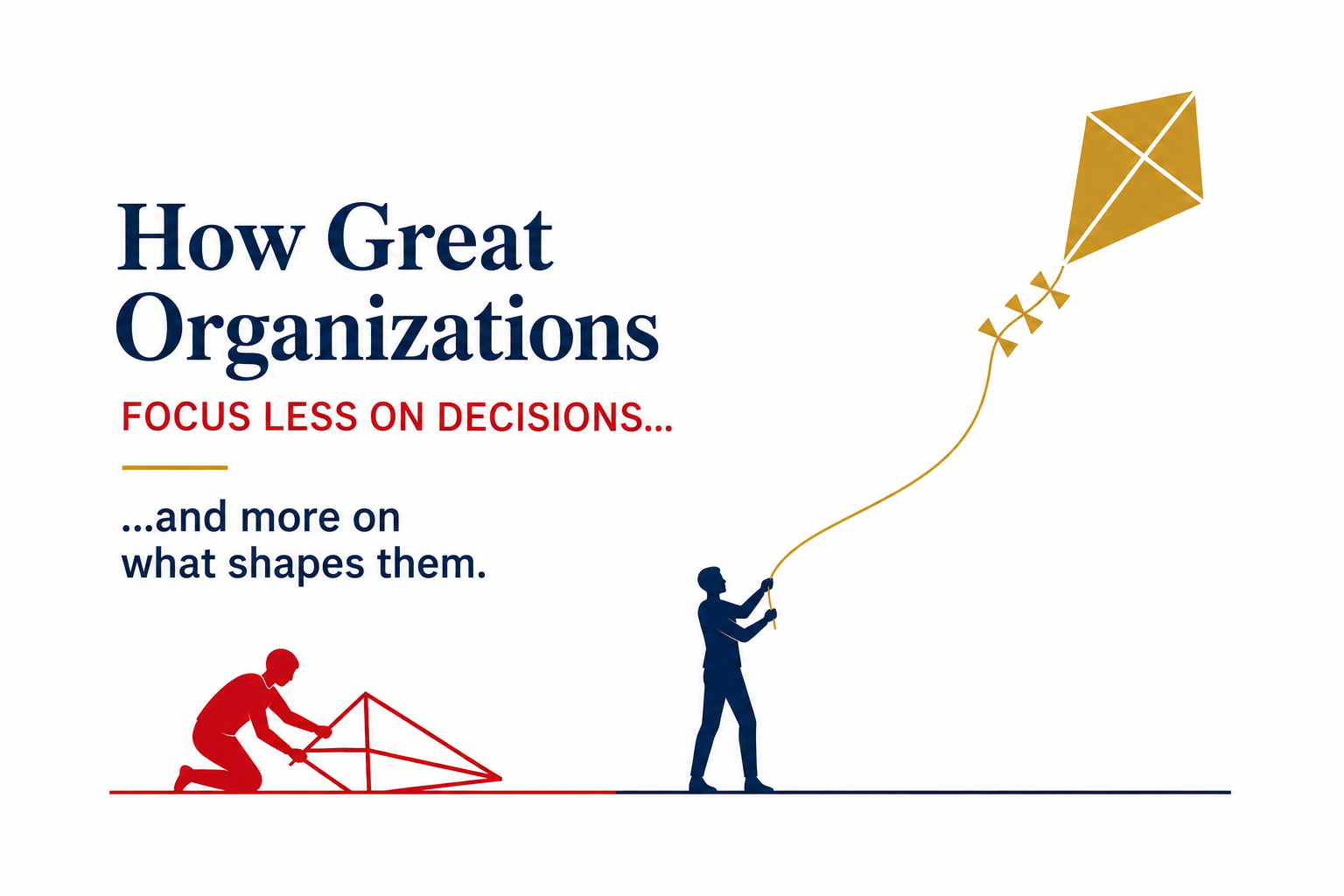
Every organization makes decisions. Far fewer understand what truly shapes them.
Leadership discussions often focus on improving decision-making through choosing the right strategy, investing in the right initiative, or responding correctly to changing market conditions. Yet decisions are rarely isolated events. They are the visible outcome of competing organizational forces that influence what leaders perceive as important in a given moment.
Prioritization is not simply a matter of selecting one task over another. It is the ongoing process of balancing competing forces that pull an organization in different directions. When those forces are understood and intentionally managed, organizations make more consistent, resilient decisions. When they are ignored, decisions become reactive, inconsistent, and increasingly difficult to sustain.
Rather than viewing priorities as a checklist, it is useful to think of them as organizational vectors. Like physical forces acting on an object, each vector exerts influence on the organization simultaneously. Leadership is less about eliminating these forces than understanding when each should become dominant.
| Organizational Vector | Pulls Toward | Often Pulls Against |
|---|---|---|
| Money | Liquidity | Quality, Values |
| Time | Speed | Quality |
| Quality | Excellence | Margin, Speed |
| Return | Efficiency | Innovation, Health |
| Health | Sustainability | Short-term Profit |
| Goals | Focus | Flexibility |
| Past Performance | Stability | Innovation |
| Values | Trust | Immediate Financial Gain |
Understanding the Eight Vectors
Each vector exists for a reason. None are inherently good or bad. Problems arise when one consistently overpowers the others.
Money provides operational flexibility, investment capacity, and resilience. Yet organizations driven exclusively by financial objectives often sacrifice customer experience, employee engagement, or long-term reputation.
Time rewards speed, responsiveness, and execution. However, compressed timelines frequently reduce quality, limit thoughtful analysis, and increase operational risk.
Quality builds customer confidence and strengthens competitive positioning. Taken to an extreme, however, the pursuit of perfection can delay execution and reduce organizational agility.
Return focuses resources toward measurable outcomes. While essential for efficient capital allocation, excessive emphasis on short-term returns can discourage innovation and strategic investment.
Health reflects the long-term sustainability of both the organization and its people. Healthy cultures tend to outperform over time, yet organizations that avoid difficult decisions in the name of stability may lose competitiveness.
Goals create alignment and accountability. At the same time, rigid adherence to predetermined objectives can prevent organizations from adapting when conditions change.
Past Performance provides valuable institutional knowledge and reduces unnecessary risk. Yet success can become a constraint when historical methods prevent adaptation to new realities.
Values establish trust with employees, customers, and stakeholders. While values occasionally require costly decisions in the short term, they often preserve organizational credibility when it matters most.
Organizational Friction
These vectors rarely operate independently.
Improving quality may increase costs. Accelerating delivery may reduce quality. Maximizing quarterly returns may compete with employee development. Preserving historical practices may slow innovation.
The objective is not to eliminate friction. Friction signals that meaningful trade-offs exist. Effective leaders recognize these tensions early and intentionally determine which vector deserves greater influence given the organization’s current circumstances.
In this sense, prioritization resembles balancing a system rather than ranking a list.
Lessons from Practice
Several widely documented organizations illustrate how prioritization shaped long-term outcomes.
The Toyota Production System prioritized quality and continuous improvement over maximizing short-term production volume. Concepts such as stopping production to correct defects initially appeared inefficient, yet they reduced waste, improved reliability, and helped establish Toyota as one of the world’s leading automotive manufacturers.
Similarly, Johnson & Johnson’s Tylenol recall in 1982 demonstrated the power of prioritizing values over immediate financial performance. The company voluntarily recalled millions of bottles following product tampering, despite significant financial cost. The decision reinforced public trust and remains one of the most frequently cited examples of effective corporate crisis management.
Neither organization optimized for a single metric. Both recognized that temporarily elevating one vector ultimately strengthened the entire system.
Optimizing the System Rather Than the Decision
Organizations often ask, What is the right decision?
A more valuable question is, Which organizational forces are shaping this decision?
Poor decisions frequently originate from healthy priorities that have become disproportionate. Cost control becomes chronic underinvestment. Speed becomes haste. Stability becomes resistance to change. Innovation becomes distraction.
The issue is seldom the presence of a particular priority. It is the absence of balance among competing priorities.
Leadership therefore becomes less about making perfect decisions and more about maintaining a prioritization system/framework capable of adapting as conditions evolve.
A Practical Framework
Before major strategic decisions, leadership teams should ask:
- Which organizational vector is currently driving this decision?
- Which vectors are being constrained or overlooked?
- Is this imbalance appropriate for our present circumstances?
- What long-term consequences could emerge if today’s dominant priority remains dominant for the next three years?
- Would this decision still make sense if viewed through the lens of customers, employees, investors, and partners simultaneously?
Warning signs of imbalance include declining quality in pursuit of speed, deteriorating culture in pursuit of returns, resistance to innovation because “it has always worked,” or financial decisions that gradually erode organizational trust.
Healthy organizations periodically reassess which vector deserves temporary priority while ensuring no single force permanently dominates the others.
Final Perspective
Organizations do not succeed because they consistently make perfect decisions. They succeed because they build systems that consistently produce sound decisions over time.
Prioritization is therefore not a management checklist. It is a dynamic system of competing organizational vectors.
Leadership’s responsibility is not to remove the tension between money, values, time, health, quality, return, goals, and past performance. That tension is both inevitable and necessary.
The competitive advantage belongs to organizations that recognize these forces, deliberately balance them, and understand that sustainable performance is rarely achieved by maximizing one objective. It is achieved by managing the friction between many.