

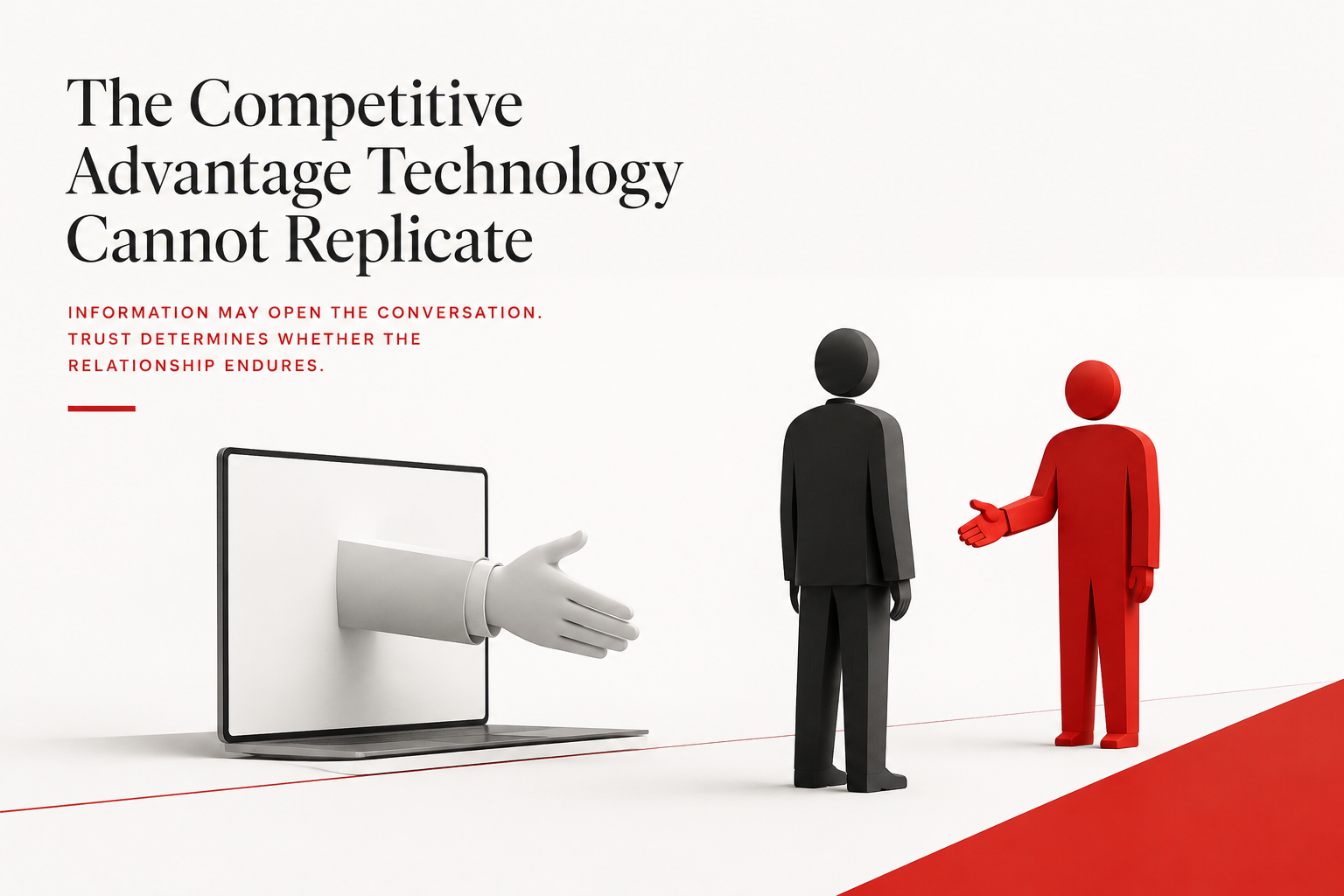
Businesses have never possessed more information than they do today.
Data reveals patterns that once remained hidden. Advanced analytics can identify trends, evaluate markets, prioritize opportunities, and process millions of variables in moments. Organizations now have access to intelligence that previous generations of business leaders could scarcely imagine.
These tools have transformed the way decisions are made.
They have not changed why people choose to do business together.
Every meaningful business relationship eventually arrives at a point where information no longer provides the answer.
That point is trust.
Technology can identify prospective customers. It can recommend acquisition targets, strategic partners, and investment opportunities with remarkable precision. What it cannot evaluate is the quality of a person’s character, the sincerity behind a commitment, or the confidence that develops only through consistent actions over time.
Those decisions still belong to people.
For organizations built on partnerships, advisory services, collaboration, or long-term client relationships, information is only the beginning of the conversation.
The outcome is determined elsewhere.
Selecting a strategic partner has never been solely about capability. Experience matters. Expertise matters. Financial strength matters. Yet every significant business decision eventually becomes a question of confidence.
Can this organization be trusted?
Perhaps the more important question is this:
Would others answer that question the same way about us?
The strongest organizations understand that reputation is not created through marketing campaigns or carefully written mission statements. It is earned one conversation, one commitment, and one decision at a time. Credibility accumulates slowly and is tested continuously.
History provides compelling examples.
In 1982, seven people died after cyanide-laced Tylenol capsules entered the marketplace through criminal tampering after the product had left Johnson & Johnson’s manufacturing facilities. Although the company bore no responsibility for the crime itself, its leadership immediately recalled approximately 31 million bottles nationwide, halted production, and communicated openly with consumers, retailers, and regulators. The decision cost more than $100 million, but it preserved something far more valuable than quarterly earnings. It preserved public confidence. Tylenol ultimately regained its market leadership because consumers believed the company had acted with integrity when it mattered most.
The opposite lesson can be found in Wells Fargo.
The bank possessed sophisticated analytics, extensive customer data, and one of the most recognized financial brands in the United States. Yet pressure to satisfy aggressive sales goals led employees to create millions of unauthorized customer accounts. The technology functioned as intended. The reporting systems worked. Performance metrics were achieved.
Trust failed.
The financial penalties reached billions of dollars. More damaging was the loss of confidence among customers, investors, regulators, and employees. Years of credibility were diminished not because information was unavailable, but because integrity had been compromised.
These examples illustrate a principle that extends far beyond crisis management.
Information identifies opportunity.
Trust determines whether opportunity becomes a lasting relationship.
As technology continues to reshape business, organizations will become faster, more informed, and increasingly efficient. Those advantages are meaningful, but they are also becoming widely available.
Trust remains different.
It cannot be purchased. It cannot be delegated. It cannot be automated.
It is reflected in how commitments are honored, how difficult conversations are handled, how customers are treated when problems arise, and whether actions consistently align with stated values.
Technology can improve judgment.
It cannot replace character.
The organizations that create enduring competitive advantages will not necessarily be those with access to the most information. They will be those that pair intelligence with credibility, innovation with accountability, and capability with integrity.
Information may open the conversation.
Trust determines whether the relationship endures.