

There is a word every business owner eventually becomes familiar with: no.
It comes from the prospect, the investor, the potential partner, the market, and sometimes from the person who simply does not understand what you are building. For entrepreneurs, the natural temptation is to interpret rejection as evidence that something is wrong with the vision.
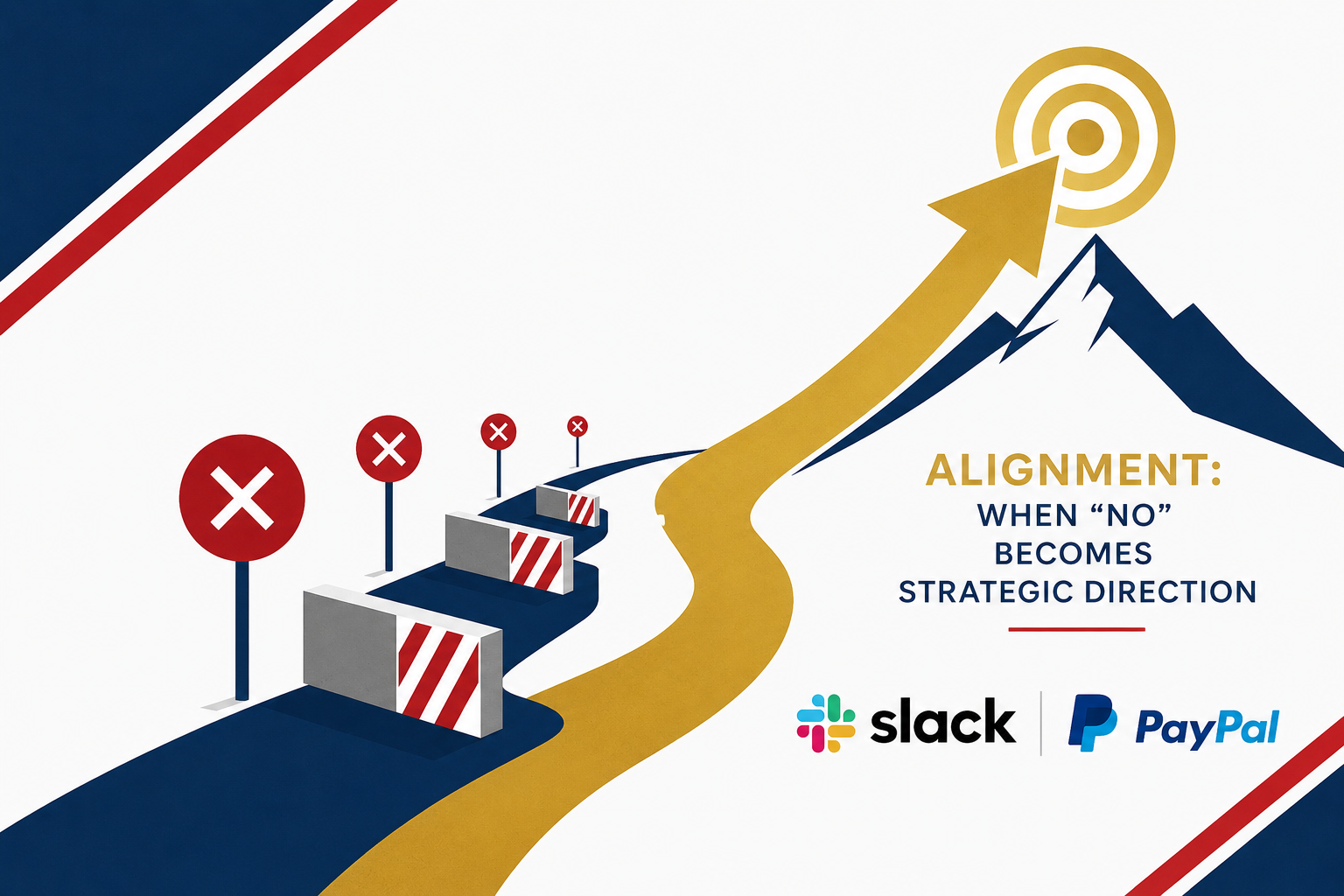
Sometimes it is. But sometimes “no” is not the end of the vision. Sometimes it is the mechanism that forces the business to become more aligned with it.
That distinction matters because business owners are not responsible for making everyone see the vision. They are responsible for building something capable of standing on its own. Ultimately, the products and services have to communicate the vision. Customers do not have to believe in the dream with the same conviction as the founder. They have to experience the value of what was built.
Once that distinction becomes clear, the relationship with rejection begins to change. Instead of fearing every no, a business leader can begin listening to it.
There is an important difference between abandoning a vision and changing the path toward it. If the purpose of a business changes every time someone says no, the organization is not becoming aligned; it is reacting. But remaining committed to the underlying purpose while being willing to change the product, market, delivery model, customer or strategy is something different.
That is alignment.
Alignment is the ability to distinguish between what must remain and what must change. The purpose may remain while the strategy changes. The vision may remain while the vehicle changes. The commitment may remain while the execution changes completely.
This distinction creates a different kind of discipline. Once every rejection no longer carries the power to destroy the vision, there is room to slow down, evaluate what happened, make a better decision and move toward the next opportunity. There is less pressure to force the wrong door open. Over time, what initially appeared to be an obstacle may begin to look more like information.
The business itself eventually has to become evidence of the vision. A company cannot operate indefinitely around explanations of what it could become. The product has to work. The service has to solve something. Customers have to recognize value. The market has to respond. The organization has to execute.
Vision without execution remains intention. Execution without alignment can become activity without direction. The objective is to bring the two together.
The history of Slack provides a useful example. Stewart Butterfield’s team was not originally building a workplace communications platform. They were building a multiplayer online game called Glitch. Significant resources and a substantial team went into the product, but Glitch failed to develop the sustainable audience necessary to continue. The game was shut down in 2012.
That could have been interpreted simply as failure. Instead, the team paid attention to something it had developed while building the game: an internal communication system that allowed its geographically distributed team to work together effectively.
The original product had failed, but the process of building it had produced something else of value. More importantly, the team already had evidence that the communication tool worked because they were using it themselves.
Butterfield and his team made the difficult decision to leave the original concept behind and pursue the communication product. There was skepticism about the new direction, including from investors. The skepticism, however, did not determine the eventual outcome. The product did.
Slack became one of the defining workplace communication platforms of its generation and was acquired by Salesforce for approximately $27.7 billion in 2021.
The lesson is larger than the familiar idea that companies should pivot when something fails. The failure of the original product created the conditions for greater alignment. The team stopped attempting to force a product into a market that was not sufficiently responding and paid attention to what was actually working.
The no created room to see it.
PayPal provides another example. The company that eventually became PayPal did not begin with the dominant online payment model with which it became associated. Confinity initially focused on transferring money between Palm devices. That particular application did not become the enduring opportunity. The company discovered considerably greater potential in allowing people to send payments through email.
The significance of that change was not merely technological. It moved the business away from dependence on a particular piece of hardware and toward a much broader behavior: sending and receiving money online.
Another signal then appeared. People conducting transactions on eBay were increasingly using PayPal. Rather than remaining committed to the original expression of the business, the company followed the behavior demonstrating actual market demand. PayPal eventually became deeply associated with online commerce, and eBay acquired the company for approximately $1.5 billion in 2002.
The vision did not necessarily disappear. The vehicle changed.
This is where rejection becomes useful business intelligence. Markets rarely provide certainty. They provide signals, and those signals have to be interpreted.
A prospect saying no may indicate that the price is wrong, the positioning is unclear, the timing is poor or the company is speaking to the wrong customer. An investor declining an opportunity may be signaling that the story has not yet been sufficiently demonstrated. A product struggling to gain traction may indicate that the underlying problem is not urgent enough. A market refusing to respond may suggest that the solution needs to be repositioned.
The mistake is assuming that every no means the same thing.
Some mean stop. Some mean change. Some mean not yet. Some simply mean that the business is looking in the wrong place.
The disciplined business leader learns to tell the difference.
That discipline also creates a different kind of confidence. There comes a point in building a business when leadership becomes less emotionally dependent on each individual outcome. The deal still matters. The customer still matters. The investment still matters. But one person’s rejection no longer has the authority to define the future of the company.
At that point, a more valuable question becomes possible: What is this no actually telling us?
Is the customer rejecting the problem itself, the proposed solution, the price, the timing, the way the value was communicated, or is this simply the wrong customer? Those are fundamentally different conclusions, and each requires a different strategic response.
This is where alignment moves from philosophy into practice.
Entrepreneurs can become emotionally attached to the first expression of a vision. That attachment can become dangerous because the first product may not ultimately be the product. The first market may not be the market. The first customer may not be the customer. The first business model may not become the enduring business model.
The more important question is whether leadership can remain committed to the underlying purpose while remaining intellectually honest about the vehicle being used to pursue it.
Slack did not remain a gaming company simply because gaming was the original plan. PayPal did not remain focused on Palm-based payments simply because that was where the company began. In both cases, evidence required change.
That is not an absence of persistence. It is a more disciplined form of it.
Mature businesses learn not to confuse persistence with stubbornness.
Eventually, when the business becomes sufficiently aligned, something else begins to happen. Leadership no longer has to explain everything. The organization begins speaking for itself. Customers understand the value. The product reinforces the positioning. The team understands the direction. The market begins responding. Strategy becomes clearer because the organization is no longer fighting against the evidence in front of it.
That is when vision begins to manifest through execution.
It does not happen because every door opens or because rejection disappears. It happens because the business remains committed enough to its purpose to continue moving while remaining flexible enough to recognize the right expression of that purpose.
Perhaps that is the greatest advantage of alignment. It does not eliminate rejection. It changes the question rejection creates.
Instead of asking, “What does this no mean about my vision?” the better question becomes, “What is this no teaching me about how the vision needs to be built?”
Businesses are not built by getting everyone to say yes. They are built by understanding which opportunities deserve a yes, recognizing what a no may be revealing, and having the discipline to keep moving until purpose, market and execution begin to meet.
The vision does not always arrive in the form originally imagined. Sometimes it emerges through what had to be built after the first idea did not work.
And sometimes the door that closes is the one that finally creates enough room to see the right one.
That is alignment.